
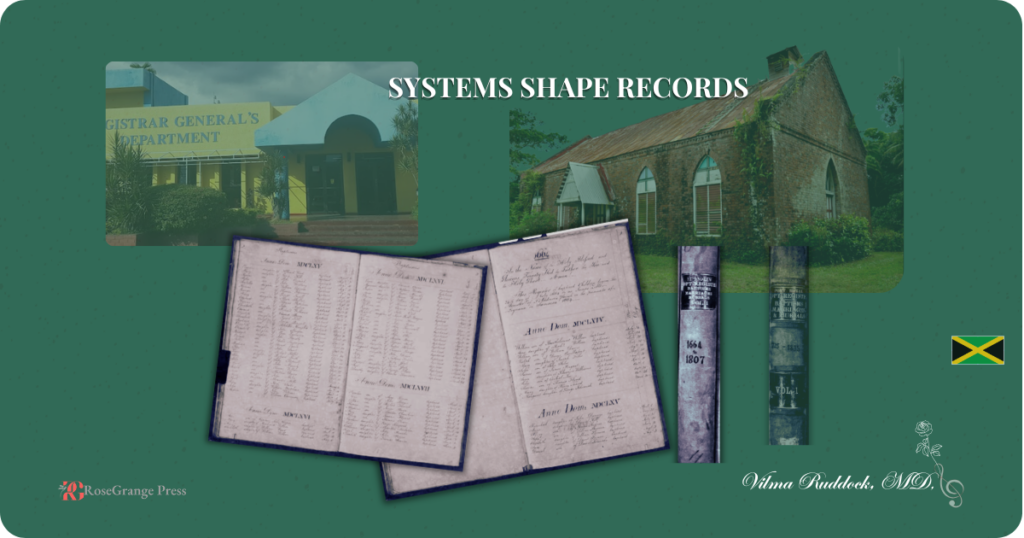
Systems Shape Records
By Vilma Ruddock, M.D.
At some point in Jamaican genealogy research, everyone encounters puzzles in Jamaica’s records:
- A name spelling changes between documents.
- A person’s age varies by ten years.
- The father’s name is missing from a baptism record.
- An entire family line seems to vanish between generations
It is tempting to conclude that Jamaica neglected its record-keeping responsibilities. That assumption isn’t entirely correct. It is important to consider historical factors that contributed to the deficiencies in the island’s records.
Fragility and Structural Gaps in Jamaica’s Records
Jamaica’s climate has never been kind to paper. Registers were damaged or lost by
- Humidity and insects
- Natural disasters
- The passage of time
Administrative transitions were not always orderly. Some records were lost while others were never created.
Structural challenges during certain years also contributed to the absence of records. For example, for certain periods between 1664 and 1825, there were not enough clergy to adequately cover the island. Parish boundaries were large, and travel was difficult. Record-keeping could be irregular, especially outside the main parishes and towns.
But administrative structure and fragility are only part of the story.
When you understand the historical background, the gaps in the records begin to make sense.
Jamaica’s Records Were Created for Institutional Purposes
Jamaica’s colonial government created record systems for specific institutional purposes to meet administrative needs:
- Clergy recorded baptisms and marriages because sacraments mattered to the church.
- Colonial administrators recorded property transfers, taxation, wills, and legal disputes because ownership and accountability mattered to the state.
- Estate managers kept ledgers documenting the property’s business and inventory, including enslaved people, for the owners and the state.
Clergy and clerks documented what the system required, not what families would wish to preserve.
Enslaved people were poorly, if at all, captured in the island’s vital records. Others on the lower social rungs, such as indentured servants, fared slightly better.
The early colonial system was not designed to preserve complete family histories and lineages.
The Interpretive Shift
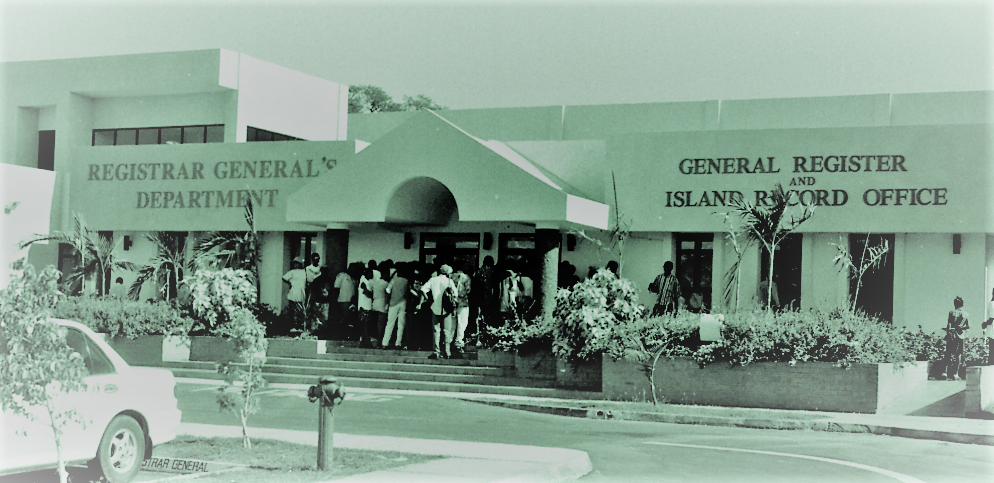
When you understand the colonial structure and systems that shaped the records, your research approach changes.
Along with asking, “Why is this missing?” You begin to ask, “What was this record designed to capture?” “What forces shaped what was recorded and what was not?”
That shift reorients your expectations. It allows you to interpret gaps without prolonged frustration and encourages you to look sideways at:
- Wills and land records
- Estate papers and family letters
- Slave registers and manumission documents
- Parish vestry minutes and parish histories
- Neighboring towns and parishes
Your research in online databases or Jamaica’s archives and registries becomes contextual rather than reactive.
Context is Key
In Jamaican genealogy, context is not just background.
It is a key insight in filling gaps in your family history research.
When you understand the historical background, the gaps in the records begin to make sense.
And in the grand scheme of things, Jamaica has managed to preserve much of its colonial records. Its preservation efforts are ongoing.
Share your experience and your breakthroughs with Jamaica’s records in the comments.