
Understanding and Navigating Gaps in Jamaican Genealogy
By Vilma Ruddock, M.D.
There comes a point in genealogical research when records become silent. Jamaican records are no exception to this experience.
You search the parish registers and can’t find your ancestor’s entry. Sometimes, you locate a baptism registration and discover that the child is unnamed. At other times, the father’s name is missing from a birth record.
It can feel like the end of the search with no clear path forward. But in Jamaican genealogy, that silence is often structural. This post will help you understand the underpinnings and bridge gaps in the island’s record systems.
Silence Has Meaning
Silence in Jamaica’s colonial records does not signify the absence of a life or one without meaning. Some records were never created, and others were lost.
The gaps in the surviving records are due to several historical factors:
- Humidity, insects, natural disasters, insurrections, and the passage of time damaged or destroyed some registers.
- Colonial systems did not focus on documenting family histories and lineages.
- The social hierarchy of the day determined who was considered worthy and who was not.
- The government designed record-keeping systems for the administrative priorities of the state.
- Transitions between governors and other administrators were not always orderly.
This history helps you see Jamaica’s records as both institutional documents and fragile treasures.
“Silence in Jamaica’s colonial records does not signify a life without meaning.“
Where the Silences Appear in Jamaican Records
Search Jamaican documents, especially before civil registrations, and you will find:
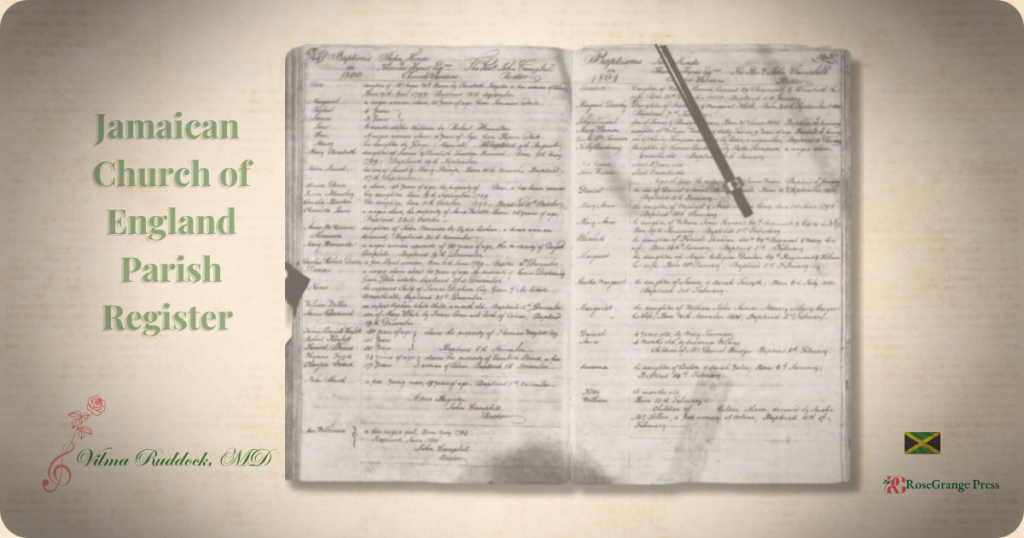
- Most enslaved people are missing from the early Church of England registers stored in Jamaica’s national registry.
- When included, the records listed many enslaved people with only a first name
- Indentured servants, convicts, and others of low social status fared slightly better
- Women disappearing from the registers after marriage
- A child of unmarried parents not recorded in a baptism register or listed without a name
- A father unnamed on a baptism registration
- Missing registers or pages, or gaps in years in a parish register
These silences reflect the concept of status within a system and the historical conditions of colonial British Jamaica.
The Silence Is Not Random
Consider these specific factors that might explain the silences in Jamaica’s records.
- A missing father’s name may reflect marital or legal status, social custom, or clerical habit.
- A vanished surname may signal migration, informal unions, or shifting naming patterns.
- A half-filled register may reflect years when no clergy were present to record vital events.
- Absence of early years in a parish register may reflect the year that the parish was created.
- Missing registers, pages, dates, or names may signify an earthquake or other natural disaster
This context sharpens your insight and helps orient your search. What is missing in the records can still guide your research.
Insight and Perspective on Your Search
When your search runs dry, gaps in Jamaica’s record-keeping can feel discouraging and limiting. It is easy to assume the end of the paper trail.
But the absence of a record does not mean the absence of a life or a family. It means the system, or history, did not capture or preserve what you now seek.
That distinction will encourage you to change how you approach your search and how you respond to the deficiencies in the records.
“What is missing in the records can still guide your search.“
How to Overcome the Barriers in Jamaican Records
The roadblocks present opportunities to use your new insights and skills to overcome the seeming barriers in your family history research.
The following strategies will help you navigate gaps in Jamaican records and move your research forward.
- Search for name variants. Use wildcards.
- Can’t find a birth record under the father’s name? Search under the mother’s surname instead.
- If the record is not yet indexed on FamilySearch, browse through the digitized parish registers on the website.
- Look for a marriage or death record if there is no baptism or birth record.
- Consider that a birth, marriage, or death may have occurred overseas.
- Search sideways: if you can’t find a record for your direct ancestor, look for records of their siblings, aunts, uncles, and cousins.
- Trace the neighbors in the district.
- Parish boundaries changed, so consider the records of the neighboring parishes and towns.
- Pay attention to associates: the informant on a birth record, witnesses on a marriage certificate, or the registrar of a vital event. Follow the trails.
- Make a habit of examining the entries or pages just before and after a record of interest. You might identify other relatives.
- Look at alternate record groups: If you can’t find your person in the parish or civil registers, look at wills, land records, estate journals, or slave registers.
- Examine alternate resources, such as tombstone inscriptions, family papers and letters, biographies, newspapers, and handbooks.
With this grounded approach, your research becomes strategic and focused.
“Let the gaps in the records guide you to look deeper and more creatively.“
Closing Reflections
The silences in Jamaica’s record-keeping are both intriguing and challenging. The colonial systems did not record every life in full, and some names are lost to time. But this does not mean your research path is blocked.
Instead, understand that for many ancestors, fragments of their history remain. With patience and diligent searching, you can connect those pieces and document your family’s lives.
Respect the reality of the silences, but remain determined in your search. Prepare yourself to persevere and do the necessary work. The results can be greatly rewarding.
Don’t let what is missing in the records discourage you. Instead, let the gaps guide you to look deeper and more creatively.
Share a success story about searching through Jamaican records for an ancestor in the comments.